
We’ve got invocation figured out. MCP for tool calls, A2A for agent-to-agent, OpenAPI for services. But ask your agent “what’s available for this task?” and you get nothing back. You’re still manually wiring in every tool, skill, and plugin, hoping you didn’t miss the better option buried in a README three repos deep.
The entire discovery layer is missing from the agentic stack.
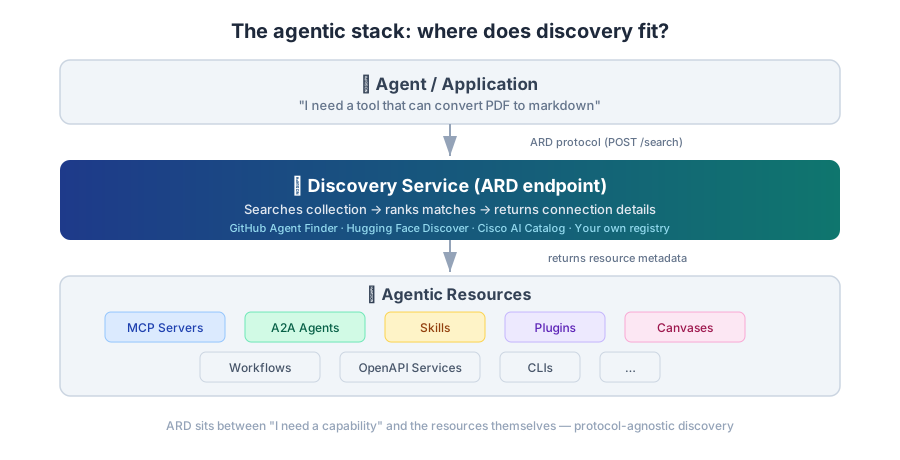
ARD: the spec
Agentic Resource Discovery (ARD) is an open spec — v0.9 draft, published under the Linux Foundation. Microsoft, Google, GitHub, Hugging Face, GoDaddy, NVIDIA, Salesforce, Snowflake, Cisco, Databricks, and ServiceNow are all behind it.
It gives registries a standard way to advertise what they have, and gives clients a standard way to search across them. The analogy people reach for is DNS — your agent asks “who can do X?” and the registry answers with matching resources and connection details. It sits before invocation, works with MCP servers, A2A agents, OpenAPI services, CLIs, skills, whatever, and is federated so multiple registries can coexist and cross-reference each other.
The spec defines a query model (text search, faceted filters, pagination), a manifest format for describing resources, conformance rules, and federation referrals that let one registry point you to another.
As Angie Jones explains in her writeup on AI Catalog, discovery is an ecosystem problem, not a protocol-specific one. An agent workflow might need an MCP server for market data, an A2A agent for reasoning, a CLI tool for local operations, and a skills plugin for domain prompts. Each artifact type has its own native metadata format — ARD doesn’t try to replace those. It provides a common discovery layer around them: a typed JSON catalog where each entry declares what kind of artifact it is via mediaType, and clients can fetch and process entries they understand while skipping the rest.
Real implementations, not just a spec
The reason I’m writing about this now and not in six months is that real implementations already exist:
GitHub Agent Finder — built into GitHub Copilot. Instead of pre-loading every MCP server into the context window, Copilot searches GitHub’s curated catalog of AI resources (or your own private registry) and surfaces ranked matches on demand. Agent finder only finds — it doesn’t auto-install anything. You stay in control.
Hugging Face Discover — provides search access to thousands of skills, ML applications, and MCP servers on Hugging Face and other ARD registries.
Cisco AI Catalog and Ora Directory — additional reference registries you can query today.
Google’s announcement post and Microsoft’s post on the Command Line blog both go into more detail on the motivation and architecture.
The problem: specs are hard to explore
I’ve been working with ARD, and the usual problem with new specs applies — you want to poke at real endpoints, try queries, see what the response looks like, validate your manifest, but there’s no easy way to do that without writing throwaway code.
MCP had MCP Inspector for this. ARD didn’t have anything equivalent.
So I built one.
ARD Explorer
ARD Explorer is a web UI for exploring ARD endpoints. One command, zero config:
npx ard-explorer
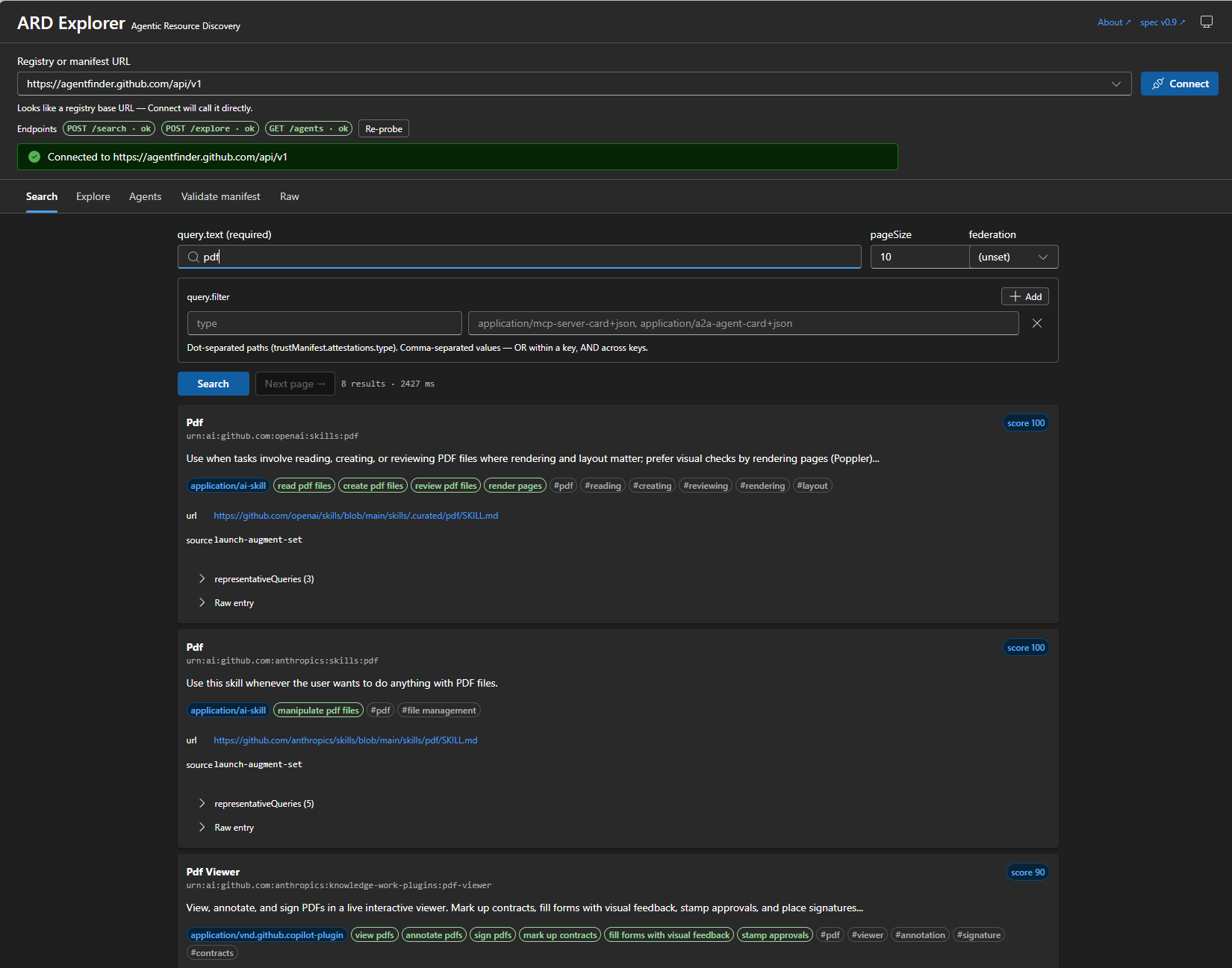
It opens a local web app where you can:
- Connect to any ARD registry by URL, or discover registries via
.well-known/ai-catalog.json - Search with the full §7.1 query model — text queries, filters, pagination, federation referrals
- Browse facets with bucket counts (see what categories and capabilities a registry exposes)
- List agents via
GET /agents - Validate manifests against the spec’s conformance rules
- Inspect raw request/response for every call (useful when you’re implementing a registry yourself)
It ships with a built-in mock registry so you can explore the query model even without a live endpoint. And it comes pre-configured with the reference implementations: Hugging Face Discover, GitHub Agent Finder, Cisco AI Catalog, and Ora Directory. Includes a proxy server to handle CORS, since browsers and cross-origin API calls don’t mix.
Try it
The agentic ecosystem has a cold start problem. Protocols for calling tools are maturing fast, but discovering tools is still ad-hoc. This isn’t just an MCP problem — it’s true for A2A agents, Skills, Plugins, Canvases, workflows, and every other kind of agentic resource. ARD standardizes that layer, and any artifact type with an agreed-upon media type can participate.
Building a registry? You can test your implementation against the query model. Evaluating ARD as a consumer? See what’s actually out there across GitHub, Hugging Face, Cisco, and more. Just curious? The mock registry lets you play with it without any setup.
The package is on npm as ard-explorer. The repo is on GitHub.
I write about building with AI agents. Follow me on LinkedIn for more.